

Document Tests
Cable tests your customer and transaction data against the controls in each framework and flags what does not pass. Some requirements cannot be evidenced that way. A board-approved policy either exists or it does not, and the officer designation and annual training records usually live as documents.
That half often lived in a shared drive, tracked in a spreadsheet someone had to keep current. Document Tests cover it. A document test is satisfied by a document rather than by data, and sits against the same controls and frameworks as everything else in Cable.
You can create your own document tests in Cable for obligations you already track outside the product. A built-in BSA/AML library is also available with support.
Key Features:
-
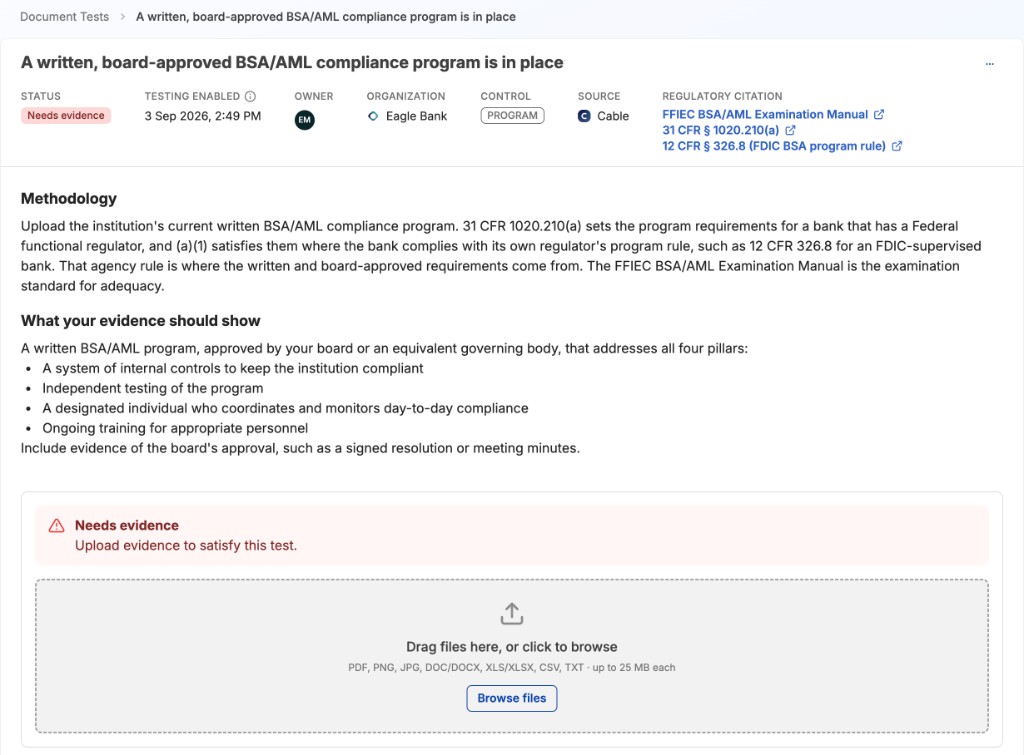
Upload Against the Requirement: Each test states what it checks and what your evidence needs to show, so you upload against the requirement itself rather than into a general document store
-
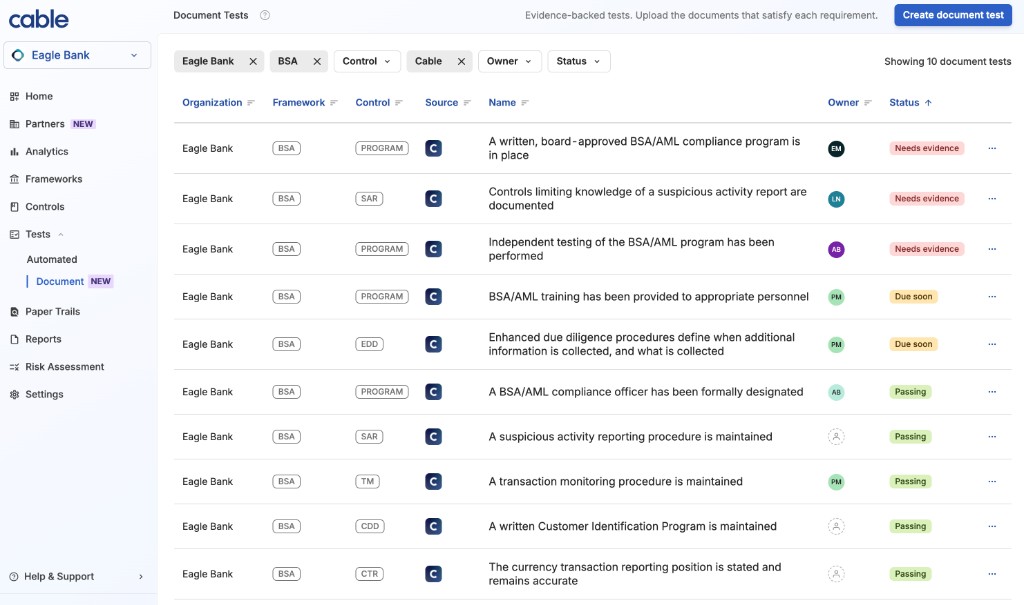
Clear Evidence Status: Tests use three statuses: Passing, Due soon, and Needs evidence. The Document Tests guide explains how renewal dates and the 30-day due-soon window work
-
Renewal Cadence Per Test: Each test sets its own cadence, so an annual policy review and a document that never expires behave differently without any manual tracking
-
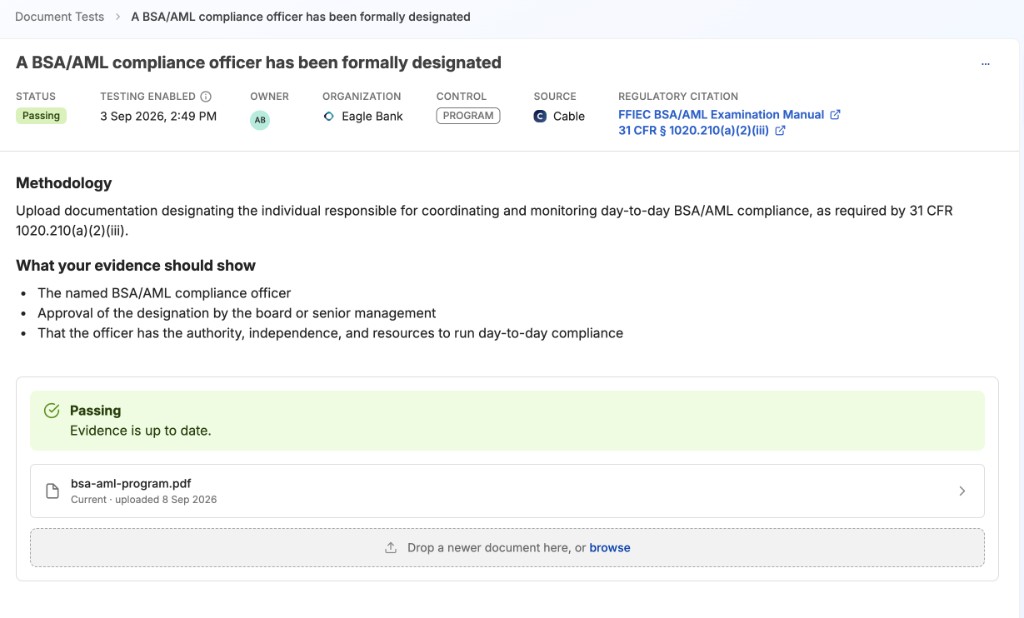
Permanent Evidence History: Submitted evidence is never overwritten or deleted. Every document a test has ever held stays attached, with who uploaded it and when
-
Same Frameworks, Separate Record: Document Tests sit against the same controls and frameworks as automated tests, while tracking evidence currency separately. They create no Paper Trails and no findings
Your controls can now show the evidence that data can prove and the documents that need to stay current. Full detail is in the Document Tests guide.
BSA/AML Document Test Library
Ten document tests are built and ready to enable, covering the BSA/AML program pillars and the procedures beneath them. Each one cites the paragraph of 31 CFR it answers to.
The four program pillars:
- A written, board-approved BSA/AML compliance program is in place
- A BSA/AML compliance officer has been formally designated
- Independent testing of the BSA/AML program has been performed
- BSA/AML training has been provided to appropriate personnel
The six operating procedures:
- A written Customer Identification Program is maintained
- Enhanced due diligence procedures define when additional information is collected, and what is collected
- A transaction monitoring procedure is maintained
- A suspicious activity reporting procedure is maintained
- Controls limiting knowledge of a suspicious activity report are documented
- The currency transaction reporting position is stated and remains accurate
Every test carries its eCFR citation, a link to the FFIEC BSA/AML Examination Manual, and a methodology listing the specific points your evidence needs to cover, so a reviewer can trace each test back to the requirement it exists for. Nine of the ten renew annually. The compliance officer designation carries no renewal date, because the designation stands until you change it.
To enable the BSA document tests for your organization, contact Synctera support.
Custom Document Tests
Where an obligation is not covered by the library, you can now author your own document test rather than tracking it outside Cable.
Key Features:
-
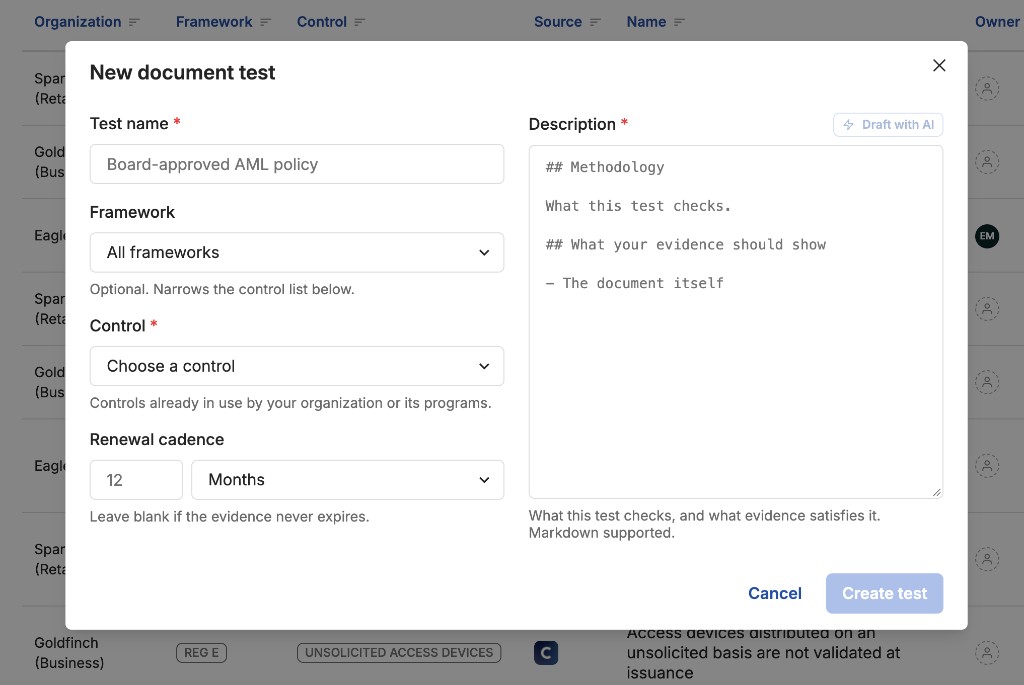
Create Your Own: Choose the control it belongs to, describe what the evidence needs to show, and set how often it must be renewed. Leave the cadence blank for an obligation whose evidence does not go stale
-
Assign Across Programs: Apply a test to every program it covers in one step. Each program gets its own copy to evidence separately, so an obligation worded once is created once
-
Same Behavior as the Library: Custom tests carry cadence, renewal, ownership, and evidence history exactly as the built-in tests do
An obligation you currently track in a spreadsheet becomes a test with an owner, a place in your framework, and a renewal date where one applies.
Test Ownership and Archiving
Document tests can now be assigned to a named person, and retired without losing what they collected. Owners are notified in Cable and by email, and anything of theirs still needing evidence appears on their home page alongside their Paper Trails. Assigning a test to yourself notifies no one.
Archiving stops a test collecting new evidence and takes it out of your active queue, while keeping everything it already holds. That evidence is the record that the obligation was met while the test was live, which is exactly what an audit asks for. Nothing deletes a document test, so who retired what, and when, stays answerable.
AI Assistance for Document Tests
Two optional AI features now sit in Document Tests. You trigger both deliberately, and neither has any bearing on a test’s status.
Key Features:
-
Draft a Description: When authoring a custom test, generate a description from its name and control, or improve a description you have already written
-
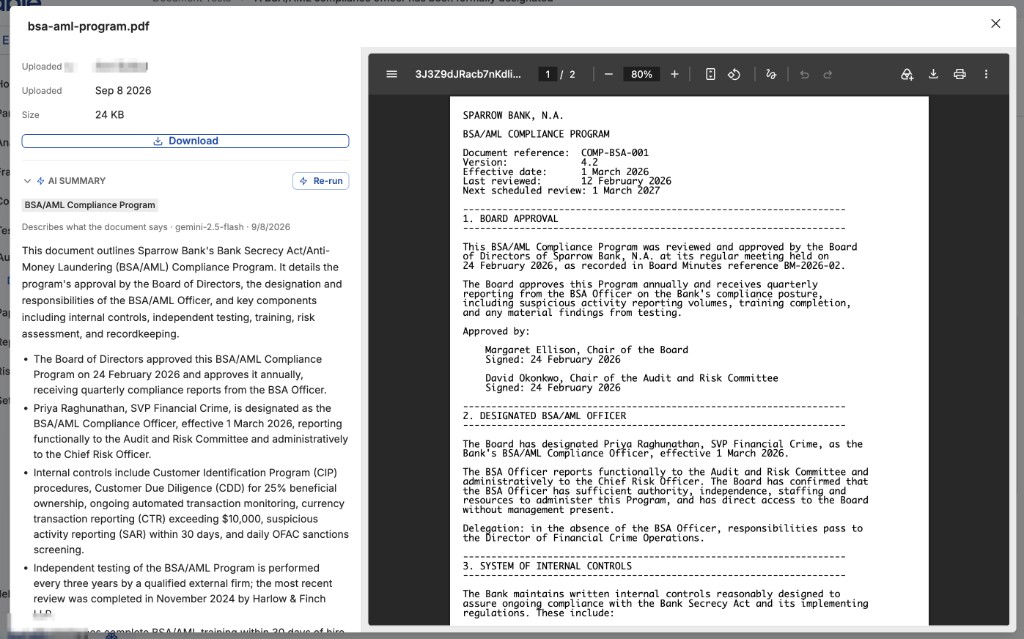
Summarize a Document: A Summarize button on any uploaded document returns a plain summary of what it says, including substantive points and recorded details like document type, dates, and signatories
-
Available to Reviewers: Summarizing needs only read access, so someone who can view a test’s evidence but not edit the test can still use it
-
Downloadable: Summaries can be downloaded alongside the document they describe
-
Status Stays Yours: A summary describes a document rather than judging it. Status is derived from the evidence on file and its renewal date alone, so it stays reproducible years after the fact
You get a faster read of a long document without handing any part of the compliance decision to a model.
Your compliance framework no longer needs to split automated checks in Cable from policy documents in a shared drive. Document Tests bring those documents into the same controls and frameworks, while keeping the compliance decision with your team.
To get started, read the Document Tests guide and create your own document test. To enable the BSA/AML library for your organization, contact Synctera support.